Saltire spent time at this year’s Northwest Math Conference, held earlier this month in Portland, where we met with mathematics educators and showed them what we have been building.
Teachers who stopped by saw how GenGX turns a plain-language description into an exact, interactive geometric figure they can explore further in GXWeb. Some who were hesitant about using AI were surprised to see a practical application for mathematics teaching. Teachers working with students as young as third grade also saw opportunities to introduce these tools to younger learners.
At the booth, our engineer demonstrated how a simple prompt could become a more involved mathematical exploration. Starting with “incircle of a triangle,” the demonstration progressed to finding the area of the incircle of a triangle with side lengths a, b, and c, then to a triangle with side lengths a, b, and (a+b)/2. Each step gave teachers a way to see how changing a description changes the construction and the mathematics they can investigate.
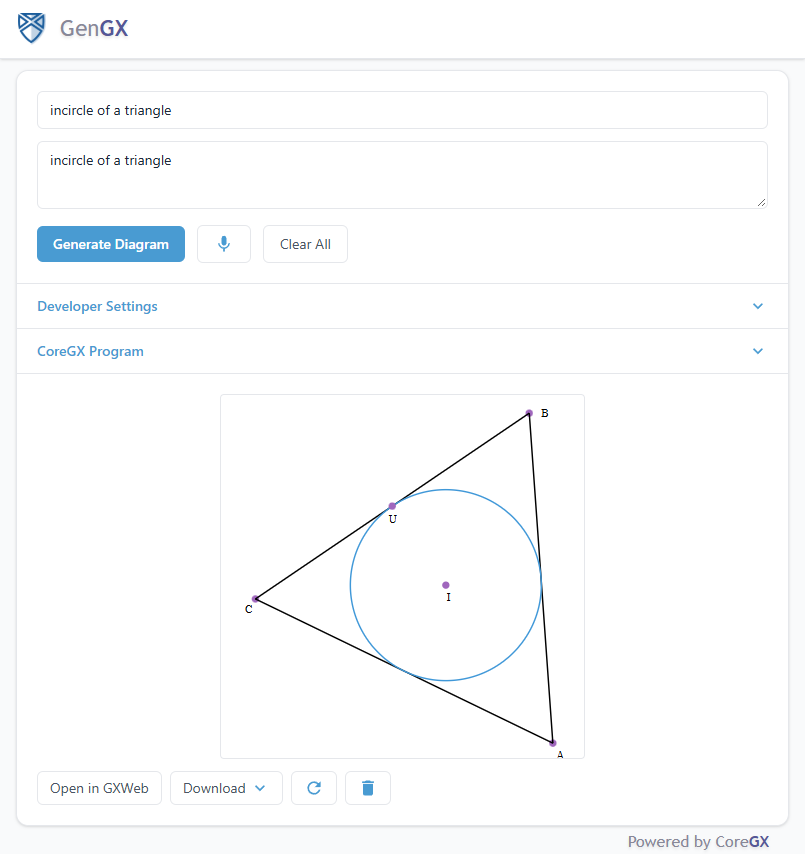
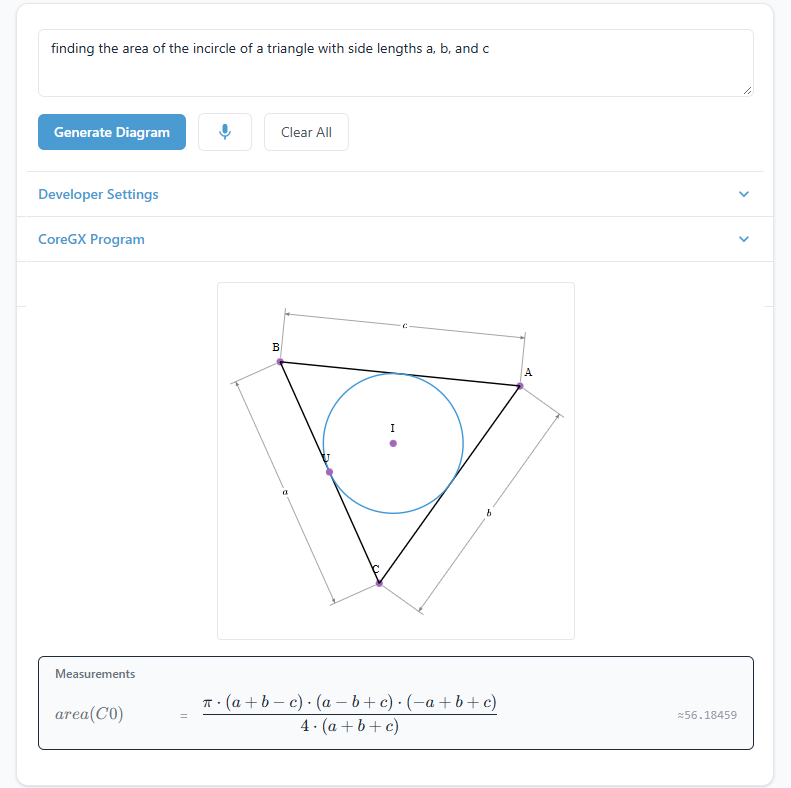
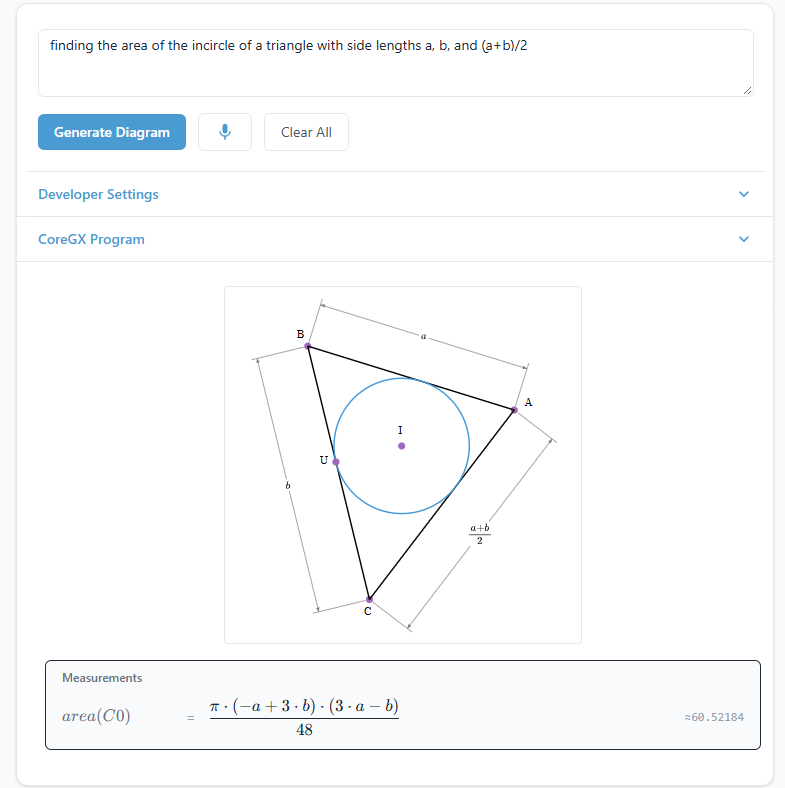
GXWeb offered another way to bring concepts to life. Teachers could model function transformations and geometric relationships directly, changing expressions or manipulating figures to explore how those changes affect a graph or construction. These demonstrations opened up conversations about using the tools across different grade levels.
Our engineer Kavi Wilson also presented “Two Talks: Generative AI, Math, and Geometry,” a demystifying look at the mathematics and techniques behind generative AI large language models, and how they're used in GenGX.
The most valuable part was hearing what teachers need! Two things came through clearly.
First, teachers would like stronger support for fundamental geometry theorems. That is on our list. Second, many teachers have spent years building lesson materials in the tools they already use and understandably do not want to rebuild that work from scratch.
Several teachers said GXWeb felt easier to use, but moving their existing materials over remained a barrier. A number said that a way to bring those lessons into GXWeb would make them ready to switch. We heard that, and we are looking closely at how to make that move easier.
Another highlight was a visit from the Sandy High School robotics team, which we sponsored last summer. It was a pleasure to reconnect when they stopped by the booth.
Thank you to everyone who came by, asked thoughtful questions, and shared what would help in your classroom. That feedback shapes what we build next.
GenGX and GXWeb are free to try. If you teach math and have ideas about what would make these tools work better for you, we would love to hear from you. Drop us a line at feedback@geometryexpressions.com!